








By Mao Xinhui and Wang Xiuyuan
Fuxing Island has recently captured public attention like never before.
Once a "strategic blank zone," it is now home to the Quantum City Spatial Innovation Base and a trending destination among young visitors known as "Pain Island." Covering just 1.3 square kilometers, the island is transforming from an industrial rust belt into a model of the future city. As the only inland island on the Huangpu River, it is setting sail toward a smarter and more vibrant future, powered by technology and guided by art.
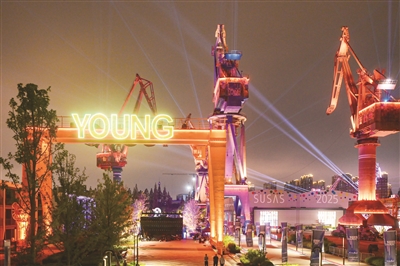
From 30 September to 13 December, the 2025 Shanghai Urban Space Art Season is taking place on Fuxing Island under the theme Quantum City, Reviving the Future. The event aligns closely with the island's development vision. More than an art-and-technology showcase, it serves as a bold experiment in future-oriented urban governance.
Fuxing Island was once a major industrial hub in modern Shanghai, home to enterprises such as the China State Shipbuilding Corporation. As the city shifted away from heavy industry, the island became a "forgotten corner." It wasn't until the Shanghai 2035 Master Plan designated it as a "strategic reserve area" that the land began gathering new momentum.
Now, with the establishment of the Quantum City Spatial Innovation Base, Fuxing Island is evolving from a blank canvas into a testbed for innovation. Xu Mingqian, Deputy Director of the Shanghai Municipal Bureau of Planning and Natural Resources, said the island's relatively isolated setting and rich industrial heritage provide ideal conditions for exploring the concept of a "quantum city." Built on precision sensing, efficient coordination, and intelligent interaction, this approach positions Fuxing Island as a platform for policy innovation, technological progress, and spatial renewal, creating an integrated and inspiring model for urban transformation. The "quantum city" is not an unreachable vision.
According to Xu, the concept draws metaphorical inspiration from quantum principles such as precision, synergy, superposition, and leap. Using technologies like AI, digital twins, and 3D real-scene modeling, it aims to build a city system capable of real-time sensing, intelligent analysis, and automatic optimization. In December 2024, construction officially began on the Quantum City Spatial Innovation Base on Fuxing Island—marking a major step forward for Shanghai in building virtual cities and advancing digital twin technology.
For ordinary citizens, a "quantum city" means a smarter, safer, and more efficient urban life. Imagine traffic lights that adjust automatically to real-time road conditions, air quality monitoring precise down to the neighborhood level, dynamic tracking and prediction of pedestrian flows, or flood alerts that generate solutions in advance. These innovations will all be tested first on Fuxing Island.
At the same time, citywide spatial monitoring and 3D digital modelling are providing the "digital foundation" for a smart city, helping governance shift from experience-based to data-driven. According to Pang Chong, Deputy Director of the Ministry of Natural Resources' Bureau of Territorial Spatial Planning, familiar urban elements such as roads, public transport stops, parks, shopping centers, fitness venues and healthcare facilities can all be translated into measurable digital indicators. Examples include the 15-minute walking coverage of community healthcare services, the 5-minute coverage of elderly care facilities, and accessibility measures for commuting, medical care, dining, shopping, parking and leisure. These data points reflect not only citizens' sense of happiness and fulfilment but also the city's overall development quality and business environment. Through 3D modelling, the city's terrain, waterways and building layouts can be recreated with precision in digital form. This allows planners to assess spatial strategies and governance more effectively, and even use artificial intelligence to simulate possible futures, making urban design more scientific and forward-looking.
In 2019, the third Shanghai Urban Space Art Season opened along the Yangpu waterfront under the theme Encounter. A 2.7-kilometre stretch of the southern riverside was opened to the public for the first time, turning what was once an "industrial rust belt" into a vibrant riverside area. It marked a vivid example of Shanghai's people-centered approach to urban renewal.
Six years later, the Art Season has returned to Yangpu, this time on Fuxing Island.
This year's edition moves beyond traditional exhibition formats and offers immersive, interactive and family-friendly public experiences. According to officials from Yangpu District, the island's industrial relics and open spaces provide vast room for artistic imagination. The district is now accelerating Fuxing Island's transformation from a "blank canvas" into one of Shanghai's most dynamic creative zones. Following an organic and sustainable growth model, the area is revitalizing its industrial heritage and historical buildings while improving infrastructure, updating factory sites, enhancing the blue-green landscape and enriching supporting facilities. These efforts create a space for exhibitions, performances, exchanges and leisure activities that combine art, technology and community engagement. By integrating technology and art, the virtual and the physical, online and offline, the event also presents the progress of the Quantum City Spatial Innovation Base.
According to the plan, Fuxing Island will evolve along three interconnected directions. It will become a Digital Island, built on the Quantum City Spatial Innovation Base and focused on developing intelligent applications such as the low-altitude economy and autonomous driving. It will also grow into a Design Island, revitalizing existing spaces through affordable rents to attract innovators, entrepreneurs and creative professionals. At the same time, it will take shape as a People's Island, featuring waterfront walkways, festival lawns and service stations that together create inclusive public spaces for all ages.
Fuxing Island will preserve its industrial heritage while embracing technology, art and ecology to form a new waterfront community that blends work, life and leisure.
It is no longer just an island. It is a symbol, a model and a living laboratory for the future that belongs to every citizen of Shanghai.
