








By Chen Zhenxin
In the 1920s, China was poor and underdeveloped, and its people struggled to survive. Many young, progressive intellectuals were searching desperately for a way to save their country and its people. It was against this backdrop that Chen Wangdao's translation of The Communist Manifesto, the first complete edition in Chinese, appeared. Like a beacon in the darkness, it lit the way for countless revolutionaries.
How did the first complete Chinese translation of The Communist Manifesto come into being? And what memorable stories emerged as it was translated and began to reach a wider audience?
Why Chen Wangdao Was Chosen
In China in the 1920s, Marxism was one of many competing schools of thought. Anarchism, syndicalism, guild socialism and a host of other ideologies were all in circulation. Which of them could save China? At the time, the early Marxists Li Dazhao and Chen Duxiu had agreed to work together to establish the Communist Party of China. To ensure that Marxism would guide the Party from its inception, they and their fellow advocates were eager to see a complete Chinese translation of The Communist Manifesto. It was in this context that, in March 1920, 72 years after the work was first published, the 29-year-old Chen Wangdao received a letter from Shao Lizi of the Republican Daily. The letter passed on an invitation from Dai Jitao of the Weekly Review to translate the manifesto. It also came with a Japanese edition supplied by Dai and an English edition that Chen Duxiu had asked Li Dazhao to borrow from Peking University Library, so that Chen Wangdao could consult both while translating.
As the May Fourth New Culture Movement gathered momentum, excerpts from Marx and Engels's The Communist Manifesto had begun appearing in newspapers, but no one had yet translated the entire work into Chinese. Dai Jitao had wanted to take on the task himself, but felt he was not fully equipped to do so. In his view, translating the pamphlet required at least three qualifications: a thorough understanding of Marxism, fluency in at least one of three languages—German, English or Japanese—and a strong command of Chinese. While studying in Japan, Chen Wangdao had met early Japanese socialists such as Hajime Kawakami and Hitoshi Yamakawa. He was an avid reader of the articles they translated from Soviet Russia and came to embrace Marxism through their work. Fluent in both Japanese and English, and an accomplished writer in Chinese, Chen met all three requirements. Shao Lizi's recommendation was also likely influenced by Chen's work on Chinese language education reform at Zhejiang First Normal School, his role in the protests there, and the articles introducing Marxism that he had already published in newspapers. In a sense, Shao's recommendation of Chen was a choice shaped by history.
"Sweet Enough. Plenty Sweet!"
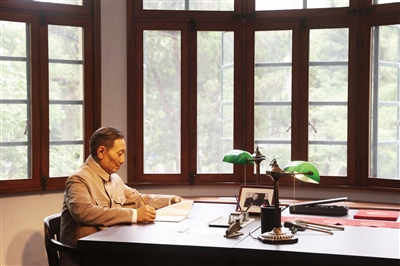
In late March 1920, Chen Wangdao returned to Fenshuitang, his home village in Yiwu, to begin translating. To escape distractions and concentrate on the work, he retreated to a woodshed a short distance from the family home. The shed was dilapidated after years of neglect. Early spring in the countryside was still bitterly cold, especially at night, when the chill left his hands and feet numb. Inside were just a few basic furnishings: a wooden bed board and two long benches. Once he began translating, his mother brought him all three meals each day, along with tea and water. Working tirelessly, day and night, he grew noticeably thinner. It pained his mother to see him this way, so she made him zongzi, sticky rice dumplings, and served them with the brown sugar for which Yiwu was known, hoping to build up his strength. Calling from outside the shed, she asked whether he needed more sugar. "Sweet enough. Plenty sweet!" he replied. Later, when she came in to clear away the dishes, she burst out laughing at the sight of ink all around his mouth. So absorbed was Chen in his translation that he had mistaken the ink in his inkstone for brown sugar and dipped his dumplings into it!
The poor working conditions were only the practical obstacles. The translation itself presented four more fundamental challenges.
First, the text was exceptionally difficult to translate. Engels himself later remarked on how hard it was to translate The Communist Manifesto, first published in 1848, into other languages.
Second, Chen was producing the first complete Chinese translation. Beyond the Japanese and English editions he was working from and two borrowed dictionaries, one English–Chinese and the other Japanese–Chinese, he had no reference materials to consult. Even so, he managed to convey the meaning of the original with considerable accuracy.
The third challenge was the tight deadline. Both the effort to establish the Party and the struggle to save the country created an urgent need for access to the full text of The Communist Manifesto. The translation could not wait.
The fourth challenge was Chen Wangdao's determination to get every detail right. He wanted as many people as possible to understand the translation, whether they read it themselves or heard it read aloud. This meant using clear, accessible language, so he translated the entire work into vernacular Chinese. At a time when vernacular writing was not yet widely used, this was a formidable task. That his translation still reads so naturally today, 106 years later, is a remarkable achievement.
His translation also contains many striking examples of expressive vernacular prose, reflecting the skill of a man who would become the founder of modern Chinese rhetoric. One such passage reads: "Religious fervour, chivalrous courage and tender affection have long since drowned in the icy waters of calculated self-interest." Such wording gives the translation a distinctly Chinese character. Despite the bitter cold and harsh working conditions, Chen persevered, working day and night. Completely absorbed in the task, he weighed every word and refined every sentence, devoting "five times more effort than [he] normally spent on translating a book". He finally completed the full translation of The Communist Manifesto in late April 1920.
Nearly 40 Editions in 18 Years
In late April 1920, villagers returning from town brought Chen Wangdao a telegram from the Weekly Review, inviting him to Shanghai to work as an editor. Chen took his completed manuscript with him. In Shanghai, he stayed at Li Hanjun's home in Sanyili and gave him the manuscript, along with the Japanese and English editions of The Communist Manifesto, to review. After Li had checked the translation, it went to Chen Duxiu for a second review before Chen Wangdao made the final revisions.
The original plan was to serialise The Communist Manifesto in the Weekly Review. However, the authorities discovered the journal's progressive leanings and ordered it to close. It was not until August 1920, with funding from the Communist International, that the Youxin Printing House published the translation under the name of the Society for the Study of Socialism, as the first title in its Socialism Studies series. In the rush to print and publish it, two characters in the title were accidentally reversed, turning Gongchandang Xuanyan into Gongdangchan Xuanyan. With its red portrait on the cover, this misprinted edition became known as the "red portrait edition" of The Communist Manifesto. Only 1,000 copies were printed. A second edition of 1,000 copies followed in September 1920. The title was corrected, and the cover portrait of Marx was changed to blue, giving it the name "blue portrait edition".
To meet the need to spread Marxism in the early years of the Communist Party of China, publishers including Pingmin Publishing House, Shanghai Bookstore and New Culture Publishing House followed Youxin in issuing large numbers of copies of The Communist Manifesto. Pingmin alone reprinted it ten times between January and May 1926, reaching its 17th edition that May. Guoguang Bookstore in Guangzhou and Changjiang Bookstore in Wuchang, Hubei, among others, subsequently brought out nearly 20 more editions. With a further three editions reprinted by the People's Publishing House in Hankou and the Youth Publishing House in Yan'an in 1937–1938, Chen Wangdao's translation appeared in nearly 40 editions over the 18 years from 1920 to 1938.
Today, only 12 copies of the first edition of Chen Wangdao's translation are known to survive in China. They are held by Shanghai Library, the Memorial of the First National Congress of the Communist Party of China, Shanghai Lu Xun Memorial Hall, Shanghai Municipal Archives, the Library of the Shanghai Academy of Social Sciences, the National Library of China, the Beijing Municipal Bureau of Cultural Heritage, the National Museum of China, Yan'an Revolutionary Memorial Hall, the Shangyu District Archives in Shaoxing, Zhejiang Province (formerly the Shangyu Municipal Archives), Wenzhou Library and the Dongying History Museum in Shandong. All are designated Grade One cultural relics, China's highest classification.
The Communist Manifesto Exhibition Hall and New Editions of Chen Wangdao's Translation
On 27 November 2012, the People's Daily published an article by Wu Zhenghua titled "The Taste of Faith". It recounted how Chen Wangdao, absorbed in translating The Communist Manifesto, dipped his rice dumplings in ink and declared, "Sweet enough. Plenty sweet!" General Secretary Xi Jinping has told or referred to this story on several occasions to illustrate the idea that "truth tastes so sweet".
In May 2018, marking the 200th anniversary of Marx's birth and the 170th anniversary of the publication of The Communist Manifesto, Fudan University converted Chen Wangdao's former residence into the Communist Manifesto Exhibition Hall and opened it to the public, with support from the Publicity Department of the CPC Shanghai Municipal Committee. After the hall opened, Fudan students and faculty who were Party members formed the "Spark" volunteer team on their own initiative, offering guided tours that told the story of how Chen, the university's former president, had translated The Communist Manifesto. Two years later, on 27 June 2020, General Secretary Xi Jinping wrote in a reply to all members of the hall's Party member volunteer team: "You are now actively sharing the story of former president Comrade Chen Wangdao's pursuit of truth and spreading Marxist theory. This is very meaningful work. I hope you will keep it up and do it even better."
Following the opening of the Communist Manifesto Exhibition Hall at Chen Wangdao's former residence, nearly ten new editions of his translation appeared between 2019 and 2025. Publishers included Democracy and Construction Press, Thread-Binding Books Publishing House, Liaoning People's Publishing House, Zhejiang Ancient Books Publishing House, Hunan People's Publishing House, China Democracy and Legal System Publishing House, Shanghai Educational Publishing House and the Publishing House of the History of the Communist Party of China. These editions have reached not only Party, government and military officials and a broad readership among intellectuals, but also teachers and students at universities and primary and secondary schools.
For more than a century, guided by the ideas of The Communist Manifesto, the Chinese people have won victory in the New Democratic Revolution, established the socialist system and successfully forged the path of socialism with Chinese characteristics, allowing the truths of Marxism to continue to flourish across China.
This article commemorates the 105th anniversary of the founding of the Communist Party of China and the 135th anniversary of Chen Wangdao's birth, both of which fall this year.
(Source: Jiefang Daily. The author is Chen Wangdao's son and a professor at Fudan University. The photograph on this page is archival image.)
