








By Mao Xinhui
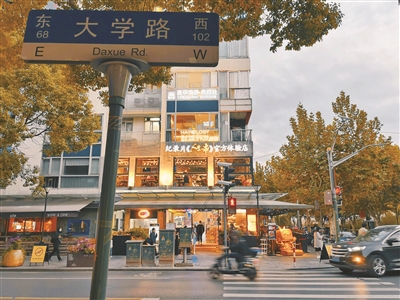
On a weekday afternoon, a café along Daxue Road is packed. On one side, students from Fudan University and Tongji University lean over laptops, debating research ideas. On the other, young engineers from Bilibili and Agora trade product concepts. The aroma of coffee mingles with the buzz of ideas. Along this road, barely a few hundred meters long, Yangpu's innovation ecosystem comes vividly into focus.
Here, there are no rigid boundaries. University campuses feel open, and corporate meeting rooms welcome outsiders. A distinctive chemistry, often described as "three-zone linkage" among university campuses, technology parks and the wider community, plays out in everyday life, forming a unique micro-cycle that sets Yangpu apart from any other district.
University Brainpower Spills Beyond the Walls
Yangpu's innovation engine begins with its universities. Yet since the start of the 14th Five-Year Plan period, a clear shift has emerged: top-tier intellect is no longer confined to papers and laboratories.
Near Fudan University's Jiangwan Campus, the Shanghai Institute for Mathematics and Interdisciplinary Sciences is now in operation. Led by Academician Yau Shing Tung, the new research institute focuses on interdisciplinary frontiers such as artificial intelligence, biomedicine and big data, with a clear mission to address strategic bottlenecks in key technologies. It serves as a beacon for Yangpu's innovation-driven firms, helping them tackle technical challenges, cultivate industry-ready talent and generate lasting impact across the broader industrial landscape.
Government has played the dual role of connector and catalyst. Over the past year, Yangpu District has signed a new round of strategic cooperation agreements with universities including Fudan University, Shanghai Jiao Tong University and Tongji University. Under a "one university, one list" approach, tailored support turns collaboration into clearly defined projects. Meanwhile, concept verification centers in areas such as green and low carbon technologies and digital health have been established to support early-stage research outcomes that often struggle to cross the gap between laboratory research and market application.
Feng Hua, founder of Raise3D, has felt this transformation firsthand. A graduate of Fudan University, he began his entrepreneurial journey in Yangpu's start up "nursery," before moving on to incubators and later accelerators. Step by step, he led the company through the stages from zero to one, and from one to ten. Today, Raise3D ranks first in China and among the global top three in the professional 3D printing sector.
Yangpu's strong entrepreneurial atmosphere left a lasting impression on him. Feng recalls that in the early days, he often attended salons at local innovation parks, where founders shared experiences and discussed potential cooperation. At every stage of development, the company received policy support and start up guidance. As the team expanded, Raise3D later moved from a training base to Wangu Science and Technology Park. There, Feng experienced an innovation ecosystem in which upstream and downstream partners are just a few floors apart, and a complete industrial chain can be found without leaving the park. "Raise3D is just one example," he said, reflecting on more than a decade of entrepreneurship in Yangpu. "On this fertile ground for innovation, countless other seeds are also growing and bearing fruit."
Over the years, Yangpu has actively promoted closer linkages among campuses, industrial parks and local communities, while steadily advancing the integrated development of industry, education and innovation. By facilitating the spillover and transformation of university research outcomes, the district has provided fertile ground for the seeds of innovation and entrepreneurship to grow.
Big Tech as an Innovation Magnet
Universities nurture the seeds, while major technology companies form a powerful magnetic force that drives clustered growth along the industrial chain.
Walking along Songhu Road toward Knowledge and Innovation Community, companies naturally gather around anchors such as Bilibili and Douyin. A dense group of firms in animation and gaming, digital content, and audio-visual technologies has taken shape. In many cases, a company's business partners are located in the building next door. This ecosystem lowers the cost of innovation and enables a level of collaboration where meeting in person is faster than sending an email.
The influence of leading companies extends well beyond their own operations. Firms such as Meituan, Bilibili and Douyin are not only major contributors to tax revenue and employment, but also key builders of the industrial ecosystem. By opening their platforms, setting up investment funds and hosting developer competitions, they have helped create space and pathways for the growth of small and medium-sized enterprises. Yangpu is now home to eight municipal-level innovation-oriented corporate headquarters, 37 national-level "little giant" specialized and sophisticated enterprises, and 1,430 high-tech companies, many of which have grown by building on the strengths of these industry leaders.
A Supportive Climate for Innovation
Clustering hardware is easy. Cultivating the right climate is harder. What Yangpu seeks is a softer environment that makes innovators feel comfortable, and even genuinely supported.
The launch of V Hub (V Juchang) offers a telling example. As the country's first policy-backed cluster dedicated to high-quality online content creation, its design speaks directly to creators' real needs. From rent reductions and copyright services to equipment support and traffic enablement, it is not a cold office space but a creators' home built around community activities and resource matchmaking.
The Pengpai "V Creator Salon," organized by The Paper, brings mainstream media into in-depth dialogue with leading online creators, helping them sharpen the value and expression of their content while showcasing young talent. Legal salons on topics such as how creators can safeguard copyright boundaries in the AI era have offered practical guidance on copyright registration and cross-border licensing to dozens of participants. "These sessions are truly useful. They broaden our horizons and open up new possibilities for future creation," said Ren Mimi, head of one creator team based at V Hub, who is an active participant in the program. She added that the ecosystem, where offices are upstairs and salons just downstairs, suits her work perfectly.
This sense of warmth is also reflected in the way government operates. Officials in Yangpu are expected to understand the language of scientists and connect effectively with entrepreneurs. To advance the rollout of drone flight routes, a dedicated task force spent three months surveying campuses and industrial parks, identifying application scenarios and coordinating repeatedly with air traffic authorities on technical standards and safety rules. The effort resulted in five firsts for the district: the launch of the first drone-based low-altitude logistics route in a central urban area, the first route crossing elevated roads, the first drone delivery route serving universities, the release of the first district-level policy dedicated to the low-altitude economy, and the establishment of the district's first innovation alliance for low-altitude economic development. This determination to bridge the final gap from concept to real-world application signals Yangpu's openness and tolerance toward emerging industries.
Community Energy Fuels Innovation
Yangpu's ecosystem has never confined innovation to glass-box industrial parks. Instead, it allows new ideas to grow within the everyday life of local communities.
Daxue Road is more than a time-limited pedestrian street. It functions as an open urban living room, where popular cafés, independent bookstores and public art installations sit alongside research institutions. Engineers can step downstairs for a specialty coffee, while professors can turn a corner to join a community salon. This mix of uses creates unexpected encounters and sparks fresh ideas.
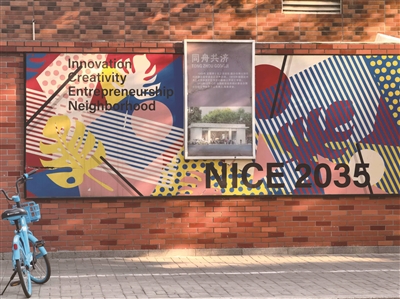
Around Tongji University, the NICE2035 initiative brings this concept to its fullest expression. The project aims to renew the Chifeng Road area into a continuously evolving "living laboratory," where future models of housing, mobility and consumption can be tested first. Innovation, once framed in abstract technical terms, is brought back to its original purpose: solving real problems in everyday life.
Perhaps this is the true formula behind Yangpu's innovation ecosystem. Rather than pursuing grand narratives, the district has patiently woven a dense and flexible network shaped by academic insight, industrial momentum, community vitality and responsive government services. It captures the essence of Yangpu's innovation efforts during the 14th Five-Year Plan period and sets a clear direction for high-quality development in the years ahead. Within this network, every exchange of ideas, every successful match of needs and every timely act of support becomes part of the district's steady and vibrant pulse forward.
