








By Lu Junyan & Sun peijie
"You have to be able to accept the loneliness and be patient if you want to be something like a craftsman. Craftsmanship is all about the drive to study and the passion for the techniques," this is what was engraved in the heart of Lu Xiaofei, a Gen-Z girl born after 2000, about professionalism when it was said by Teacher Yao, head of the Food Teaching and Research Office at Shanghai Trade School.
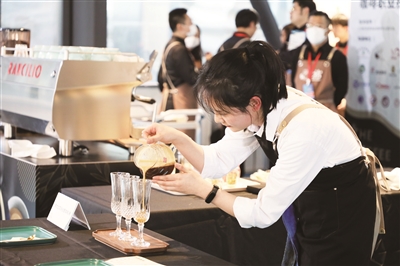
A student of Shanghai Trade School and the winner of the 2nd "Four Brands" Occupational Skills Competition "Blended Coffee Making," Lu Xiaofei once again won at the 3rd Shanghai Barista Championship.
Coffee has three flavors: bitter, sour, and sweet. To make a cup of coffee is a multi-procedure process that includes selecting coffee beans, baking, grinding, and extracting, the so-called "life of coffee" that mimics Lu's own experience as a coffee maker.
Lu's beginning major was bakery. She was selected by the World Skills Competition Baking project in 2019, but after two months of training, she was transferred to the western pastry major. "My head teacher told me that 'we sent you to do western pastry was because we believed that whichever field you are in, you can do very well!'" Lu told the reporter that two months of western pastry training shaped her temperament.
This summer, to prepare for the "Four Brands" Occupational Skills Competition, Lu once again walked into the practical training room, and challenged herself in a new field coffee-making. The reason she chose coffee-making was because she wanted to "get a brand-new skill." However, what she did not expect after trying was that she "found in herself a passion for coffee-making".
For Lu, the "milk texturing" in coffee-making was one of the challenges she had encountered during the process.
There were both failures and successes during numerous attempts, and whichever it was, she always carried on. In the three months' preparation for the competition, she could not remember how many times she had practiced, and only knew that she had used at least half a kilogram of coffee beans every day, and one day she used one kilogram of coffee beans, equivalent of 120 cups of coffee.
The utmost support was from the school. Besides guidance from subject teachers, the school had also provided students with professional equipment like that of a real café. The practical training room has a collection of over 70 varieties of coffee beans from different production regions. From smelling, to production, appreciation and innovation, such a supporting environment had granted a know-nothing rookie like Lu Xiaofei the precious opportunity to develop rapidly.
For Shanghai Trade School, the award-winning Lu Xiaofei is only one of its outstanding students. The school is aimed at building an integrated talent development system that consists of four elements of "teaching, training, practicing and competing." The world skills competition has been taken as an opportunity to integrate its ethos and advanced skill standards into the school's daily teaching and educational practices, and furthermore, to build a curriculum and teaching methodology system that meets international standards.
He Xiaocong, deputy head of the food teaching department of Shanghai Trade School, said that as people's lives are getting better and better, coffee culture has become an inevitable force that has propelled coffee sales at an unprecedented speed, and many stores have switched to a multi-product business model that sells not only coffee, but also pastries and meals. Such changes in consumers' behaviors have led to businesses' demands for alternative talents in food industry. Against such backdrop, Shanghai Trade School has done a thorough research on the coffee market and coffee curriculum, and introduced the City & Guilds' International Award in Barista Skills professional qualification system into the school's food major that was originally centered on bakery.
The school not only teaches how to make coffee, but also teach coffee appreciation, product development, customer services and other courses arising from the public's needs. In the meantime, students who passed the assessment can obtain an internationally-recognized professional qualification certificate.
Some said Lu Xiaofei was a "dark horse," but she preferred to describe herself as the "second wave" in the coffee industry, whose success was only made possible by riding on the strength of the "first wave."
