








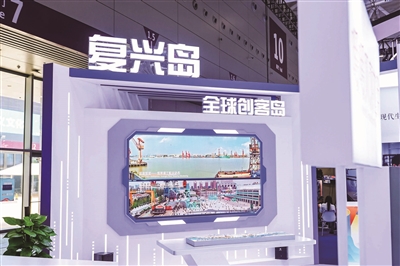
Not long ago, Shanghai's Fuxing Island launched a real world platform for embodied AI training, testing, and experimentation. To welcome the first group of embodied intelligent agents, robots from seven companies were awarded "Silicon-Based Resident IDs" for the Global Maker Island, officially becoming the island's newest "residents."
At the event, the trial version of the Shanghai Fuxing Island Real World Space Carbon-Silicon Coexistence Charter was also released. The charter proposes a safe, respectful, and cooperative spatial order between "carbon based life" and "silicon based embodied intelligence," opening a new exploration into how humans and AI can coexist in urban spaces. Some people remarked that "Fuxing Island is simply too far ahead of its time."
What makes Fuxing Island so forward looking is its role as a testing ground that connects the full innovation process, from basic research to technology transfer and product pilot testing. Yangpu District is currently deepening its innovation driven development strategy by making full use of its strengths in education and research. The district is working to serve as both a strong supporter and strategic partner for major scientific and technological innovation projects. It is helping local universities and research institutes strengthen basic research and original innovation capabilities, build a "special zone" for fundamental research, and create a leading hub for original innovation, further boosting the city's ability to generate breakthrough technologies.
As a result, scientists, entrepreneurs, and investors are increasingly gathering on the island. At the same time, new technologies and products are being tested in real world scenarios, bringing fresh energy to the transformation and future development of Fuxing Island.
Embodied AI Is Moving Beyond the Lab and Into Everyday City Life
Fuxing Island has never lacked a sense of science fiction.
Since the launch of Shanghai Fuxing Island, also known as the Global Maker Island, more and more former industrial buildings have been temporarily transformed into shared laboratories, proof of concept centers, pilot testing bases, and other full cycle innovation spaces. Together, they provide global innovators with a low cost, open, and diverse environment for innovation and entrepreneurship.
Embodied AI is among the technologies benefiting from this transformation. Here, intelligent agents are moving beyond laboratories and into real urban spaces, where they may unexpectedly cross paths with city residents. Along the shaded walkways in the island's northern public spaces, they may run side by side with residents as jogging companions. Inside the old factory buildings on Galaxy East Street, they may serve as delivery assistants bringing coffee to customers. Along the Huangpu River at Shipyard Park, they may take on inspection duties to identify road safety risks. At the commercial markets near Gongqing Road, they may even become sales assistants helping vendors attract customers. The island's futuristic atmosphere comes from the meeting of cutting edge technologies and real urban scenarios. In March this year, the "Innovation and Opportunity in Yangpu" application scenario matchmaking conference opened on Fuxing Island. Startup teams from across the country arrived with bold ideas, products, and solutions, hoping to find real world applications for their innovations.
In the past, opening up application scenarios usually meant governments or institutions presenting problems and waiting for technologies to solve them. Fuxing Island is taking a different approach. Technology companies are building standardized "supply side scenarios" based on practical applications, while government agencies are introducing customized "demand side scenarios" rooted in real needs. Instead of one sided waiting, technology and demand are now moving toward each other in both directions.
Above Fuxing Island, the low altitude economy is also opening up new possibilities. During last year's May Day holiday, a low altitude helicopter route was launched on the island, giving visitors a panoramic view of the city from the sky. This year, during the Spring Festival travel season, the helicopter service became a new commuting option, significantly reducing travel time across the Yangtze River Delta region. From aerial sightseeing to interprovincial commuting, a single transportation scenario is reshaping regional connectivity.
Each futuristic scenario on Fuxing Island acts like a powerful magnet, drawing global innovators and entrepreneurs to the island. To support this growing talent community, Fuxing Island is focusing on affordability, efficiency, and convenience, while improving the allocation of innovation and entrepreneurial resources. It is also working to ensure that policies and services better match the needs of innovation activities and resonate more closely with innovators from around the world.
In March this year, the Shanghai Fuxing Island OPC Super Individual Community was officially launched. Focusing closely on the needs of OPC entrepreneurs, Yangpu District has fully leveraged the combined strengths of its universities and leading companies to introduce tailored support policies. Centered on emerging sectors such as short drama content, AI agent development, and mini games, the district rolled out ten measures aimed at "investing in people, supporting technology, and integrating resources."
As one innovator put it, "On the road to entrepreneurship, who you build with matters more than where you go." Many now hope their future journey will move forward together with Fuxing Island.
Creating an Open Island Atmosphere That Inspires Young Entrepreneurs
Fuxing Island also has an artistic side.
Last year, the island was swept up in three waves of youthful energy. Xiaohongshu hosted its "RED LAND" open world adventure event, where industrial style met anime culture, attracting more than 100,000 visitors to the world's first anime themed "Pain Island" in just three days. Bilibili's "Cheers Music Festival" lit up the island as guitar music echoed through the air and crowds of young people gathered outside weathered old factory buildings, swaying to the rhythm. At the opening of the 2025 Shanghai Urban Space Art Season, visitors stood beneath towering timeworn cranes, gazing upward alongside the eyes of the "Tech Cat" installation as if entering a dialogue with a century of industrial civilization.
Together, these three events helped define the unique aesthetic of this "future city test ground" by creating an open island atmosphere that young entrepreneurs genuinely enjoy and that sparks creativity.
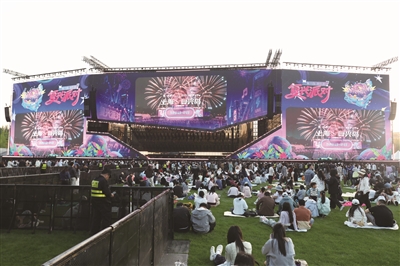
Whatever young people love, Fuxing Island does its best to make happen. One example was a lawn music festival on an unprecedented scale. On May 1, the inaugural "Fuxing Party" Music Festival was held on the island. To host the event, Fuxing Island developed the island north public space, now the largest waterfront public space along the Yangpu riverside.
Hidden within the island at the center of the river, the space serves as both a natural urban living room and a 154,000 square meter riverside retreat. Nearly 70 percent of the waterfront area is covered in greenery, blending nature, river views, and urban vitality into one landscape. The three themed zones each offer a distinct experience. The entrance lawn area features an expansive central lawn of around 80,000 square meters, ideal for walking, camping, picnicking, or simply relaxing. In the flower meadow and woodland area, floral landscapes intertwine with forest paths that wind quietly through the greenery. At the northern ecological zone, birds thrive in a peaceful habitat where visitors can enjoy panoramic river views and birdwatching from elevated platforms.
Today, former industrial buildings across the island are gradually being converted into temporary innovation spaces, giving new life to historic structures that once witnessed the city's industrial growth. While preserving the island's original character, these spaces are also being infused with functions for innovation and entrepreneurship through platforms, training programs, and public events designed to attract talented innovators and entrepreneurs.
What was once an industrial site that witnessed a century of China's shipbuilding history has now become one of the city's most popular waterfront public spaces. Two ship platforms, more than twenty cranes, gantry structures, and other industrial relics have been carefully preserved. Towering blue and orange cranes now stand alongside vibrant flower fields and lively music events, creating a distinctive atmosphere often described as a "cyber garden."
At its core, however, a future city must still be a city for its people. Whether residents are satisfied and whether daily life becomes more convenient remain the most important standards by which urban development is judged.
(Source: Jiefang Daily)
Photos in this feature are file photos.
