








Transparent bendable cell phones, transparent foldable TV and even car windows that can display news, stock market and weather information…These fantasy scenarios that exist only in fiction movies are likely to come true in near future with continuous breakthroughs achieved in the technology of organic thin-film transistor (OTFT).
On February 10, Fudan University announced that the research team headed by Qiu Zhijun and Liu Ran in the School of Information Science and Technology has made new breakthrough in discovering OTFT function stability mechanism and put forward a unified theoretical model for interaction between water oxygen electrochemical reaction and organic thin-film charge carriers. The achievement is likely to speed up large-scale application in the area of flexible electronics. The achievement has been published by “Nature--Communications”, an internationally authoritative academic magazine.
According to Qiu Zhijun, IC-based information technology has made rapid development in the past more than half a century and caused profound transformation in people’s work and life styles. With the dimensions of semiconductors approaching quantum limits, traditional silicon IC technology may reach its end in the coming 10 to 15 years. Moore’s Law that has been supporting the development of IC for more than half a century is reaching its end as well. In the post-Moore era, information technology has to make new fundamental breakthroughs and development. It is the general trend to establish the Internet of Things (IOT).
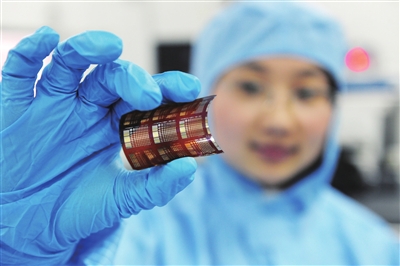
Compared with traditional electronics, flexible electronic technology is very flexible and can be printed on the surface of any materials in large scale so as to cut the production cost significantly. Additionally, the processing equipment is simple, which means the investment at the early phase is low. The process requires only low temperature and simple techniques, generating no pollution to the environment. These numerous advantages has won flexible OTFT and related IC the favor of scientific researchers.
Research in the past 30 years didn’t solve the problems such as insufficient current drive capacity, low relocation rate, poor reliability and short life span, which blocked the large-scale application of flexible OTFT.
Since 2008, the team headed by Qiu Zhijun and Liu Ran has joined efforts with Uppsala University and Royal Institute of Technology in Sweden to conduct a series of research on OTFT, hoping to essentially solve the lingering problems of operation speed and performance stability. Their research achievements have reached applicable magnitude recently.
In the application areas without so high requirement about the chip performance but flexible application in large scale, such as pad display and drive, medical imaging, wearing gear and lighting, OTFT has demonstrated broad prospects for application.
Fudan University and Royal Institute of Technology have developed a flexible wearable medical device called Bio-Patch which can be stuck to the skin like Band-it to measure people’s ECG and body temperature in real time. With IOT infrastructure becoming mature, more and more wearable intelligent medical devices will come to the life of ordinary people, bringing in significant evolution to people’s life style and healthcare.