








By Mao Xinhui, Dong Zhiwen and Zhu Liangcheng
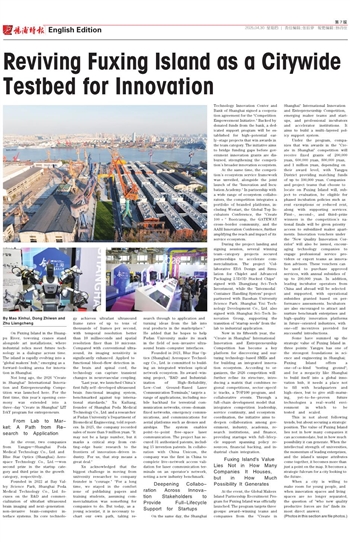
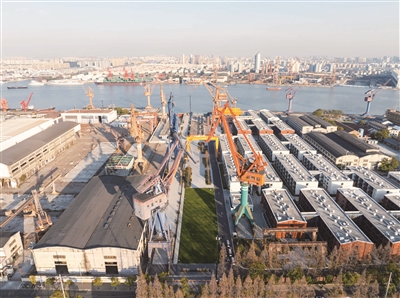
On Fuxing Island in the Huangpu River, towering cranes stand alongside art installations, where industrial relics meet future technology in a dialogue across time. The island is rapidly evolving into a "global makers' hub," emerging as a forward-looking arena for innovation in Shanghai.
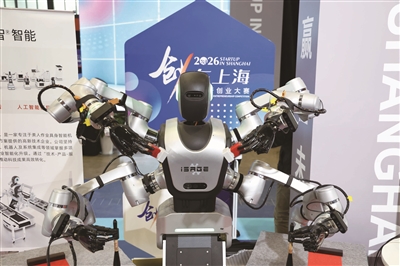
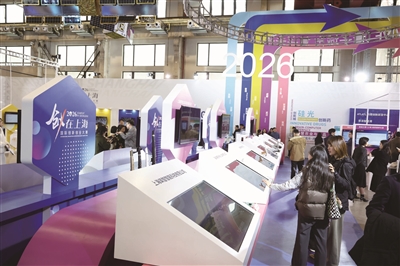
Not long ago, the 2026 "Create in Shanghai" International Innovation and Entrepreneurship Competition was launched here. For the first time, this year's opening ceremony was extended into a three-day "Create in Shanghai" LIT DAY program for entrepreneurs.
From Lab to Market: A Path from Research to Application
At the event, two companies from Yangpu—Shanghai Poda Medical Technology Co., Ltd. and Blue Star Optics (Shanghai) Aerospace Technology Co., Ltd.—won second prize in the startup category and third prize in the growth category, respectively.
Founded in 2022 at Bay Valley Science Park, Shanghai Poda Medical Technology Co., Ltd. focuses on the R&D and commercialization of ultrafast ultrasound brain imaging and next-generation non-invasive brain-computer interface systems. Its core technology achieves ultrafast ultrasound frame rates of up to tens of thousands of frames per second, with temporal resolution better than 10 milliseconds and spatial resolution finer than 10 microns. Compared with conventional ultrasound, its imaging sensitivity is significantly enhanced. Applied to functional blood-flow detection in the brain and spinal cord, the technology can capture transient changes in neurovascular coupling.
"Last year, we launched China's first fully self-developed ultrasound brain functional imaging system, benchmarked against top international standards," Xu Kailiang, founder of Shanghai Poda Medical Technology Co., Ltd. and a researcher at Fudan University's Department of Biomedical Engineering, told reporters. In 2025, the company recorded sales of more than 9 million yuan. "It may not be a large number, but it marks a critical step from cutting-edge basic research to the frontiers of innovation-driven industry. For us, that step means a great deal."
Xu acknowledged that the biggest challenge in moving from university researcher to company founder is "courage." "For a long time, we stayed in the comfort zone of publishing papers and training students, assuming commercialization was something for companies to do. But today, as a young scientist, it is necessary to chart our own path, taking research through to application and turning ideas from the lab into real products in the marketplace." He added that he hopes to help Fudan University make its mark in the field of non-invasive ultrasound brain-computer interfaces.
Founded in 2021, Blue Star Optics (Shanghai) Aerospace Technology Co., Ltd. is committed to building an integrated wireless optical network ecosystem. Its award-winning project, "R&D and Industrialization of High-Reliability, Low-Cost Ground-Based Laser Communication Terminals," targets a range of applications, including mobile backhaul for terrestrial communication networks, cross-domain fixed networks, emergency communications, and communications for aerial platforms such as drones and airships. The system enables point-to-point free-space laser communication. The project has secured 31 authorized patents, including 15 invention patents. In collaboration with China Unicom, the company was the first in China to complete live-network access validation for laser communication terminals on an operator's network, setting a new industry benchmark.
Deepening Collaboration Across Innovation Stakeholders to Provide Full-Lifecycle Support for Startups
On the same day, the Shanghai Technology Innovation Center and Bank of Shanghai signed a cooperation agreement for the "Competition Empowerment Initiative." Backed by donated funds from the bank, a dedicated support program will be established for high-potential early-stage projects that win awards in the team category. The initiative aims to bridge funding gaps before government innovation grants are disbursed, strengthening the competition's broader innovation ecosystem.
At the same time, the competition's ecosystem service framework was unveiled, alongside the joint launch of the "Innovation and Incubation Academy." In partnership with a wide range of ecosystem collaborators, the competition integrates a portfolio of branded platforms, including Westart, the Global Top Incubators Conference, the "Create 100+" Bootcamp, the GATEWAY cross-border community, and the AABI Innovation Conference, further amplifying the reach and impact of its service ecosystem.
During the project landing and signing session, several winning team-category projects secured partnerships to accelerate commercialization. The project "Collaborative EDA Design and Simulation for Chiplet and Advanced Packaging 2.5D/3D Stacked Chips" signed with Zhangjiang Sci-Tech Investment, while the "Intermodal Container Handling System" project partnered with Baoshan University Science Park. Shanghai Yixi Technology Development Co., Ltd. also signed with Shanghai Sci-Tech Innovation Group, supporting the transition of "startup seeds" from the lab to industrial application.
Now in its fifteenth year, the "Create in Shanghai" International Innovation and Entrepreneurship Competition has become a key platform for discovering and nurturing technology-based SMEs and for building an integrated innovation ecosystem. According to organizers, the 2026 competition will further refine its structure, introducing a matrix that combines regional competitions, sector-specific tracks, a TOP100 program, and collaborative events. Through a full-chain development model that integrates competition leadership, service continuity, and ecosystem coordination, the initiative aims to deepen collaboration among government, industry, academia, research institutions, and finance, providing startups with full-lifecycle support spanning policy resources, financial backing, and industrial chain integration.
Fuxing Island's Value Lies Not in How Many Companies It Houses, but in How Much Possibility It Generates
At the event, the Global Makers Island Partnership Recruitment Program for Fuxing Island was officially launched. The program targets three groups: award-winning teams and companies from the "Create in Shanghai" International Innovation and Entrepreneurship Competition, emerging maker teams and startups, and professional incubators and accelerator institutions. It aims to build a multi-layered policy support system.
Under the program, companies that win awards in the "Create in Shanghai" competition will receive fixed grants of 200,000 yuan, 600,000 yuan, 800,000 yuan, and 1 million yuan, depending on their award level, with Yangpu District providing matching funds of up to 100,000 yuan. Companies and project teams that choose to locate on Fuxing Island will, subject to evaluation, be eligible for phased incubation policies such as rent exemptions or reduced rent, along with supporting services. First-, second-, and third-prize winners in the competition's national finals will be given priority access to subsidized maker apartments. Innovation vouchers under the "New Quality Innovation Corridor" will also be issued, encouraging technology companies to engage professional service providers or expert teams as innovation advisors. These vouchers can be used to purchase approved services, with annual subsidies of up to 200,000 yuan. In addition, leading incubator operators from China and abroad will be selected and supported, with operational subsidies granted based on performance assessments. Incubators are also encouraged to attract and nurture benchmark enterprises and high-quality innovation platforms in future-oriented industries, with one-off incentives provided for successful introductions.
Some have summed up the strategic value of Fuxing Island in three points: Yangpu has one of the strongest foundations in science and engineering in Shanghai; Fuxing Island offers a one-of-a-kind "testing ground"; and for a megacity like Shanghai to build itself into a global innovation hub, it needs a place not to fill with headquarters and high-rises, but to give still-maturing, yet-to-be-proven future technologies a real-world environment in which to be tested and scaled.
This is not about following trends, but about securing a strategic position. The value of Fuxing Island lies not in how many companies it can accommodate, but in how much possibility it can generate. When the intellectual strength of universities, the momentum of leading enterprises, and the island's unique attributes come together, it becomes more than just a point on the map. It becomes a strategic fulcrum for a city looking to the future.
When a city is willing to make room for young people, and when innovation spaces and living spaces are no longer separated, the question of "who new quality productive forces are for" finds its most direct answer.
(Photos in this section are file photos.)
