


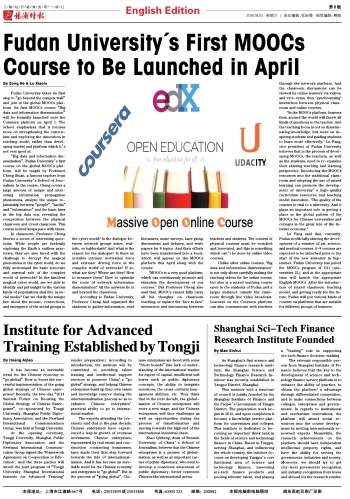






Fudan University takes its first step to “go beyond the campus wall” and join in the global MOOCs platform. Its first MOOCs course “Big data and information dissemination” will be formally launched onto the Coursera platform on April 1. The school emphasizes that it focuses more on strengthening the curriculum and exploring the innovation in teaching mode, rather than developing market and platform which it’s not very good at.
“Big data and information dissemination”, Fudan University’s first course on the global MOOCs platform, will be taught by Professor Cheng Shian, a famous teacher from Fudan University’s School of Journalism. In the course, Cheng covers a large amount of unique and interesting information propagation phenomena, analyze the unique relationship between “people”, “media” and “information” and the basic laws in the big data era, revealing the competition between the physical classroom and cloud classroom. This course indeed keeps pace with times.
In classroom, Professor Cheng throws a series of interesting questions: While people are tirelessly exploring the Earth's endless mysteries, they are also faced with the challenge to decrypt the magical phenomena in the cyber world; do we fully understand the basic structure and survival rule of the complex world of networks? In the limitless magical cyber world, are we able to identify and put insight to the various kinds of populations that live in social media? Can we clarify the unique law about the mosaic, connections, and emergence of the social groups in the cyber world? Is the dialogue between network groups sober, realistic, or balderdash? And what is the reason for the dialogue? Is there an invisible intrinsic motivation force and extrinsic driving force in the complex world of networks? If so, what are they? Where are they? How to measure them? How to optimize the route of network information dissemination? All the answers lie in and beyond the classroom.
According to Fudan University, Professor Cheng had organized the students to gather information, read literatures, make surveys, have group discussions and debates, and write papers for 8 topics. And their efforts have been transformed into a book, which will appear on the MOOCs platform this April along with the course.
"MOOCs is a very good platform, which can continuously promote and stimulate the development of our courses." But Professor Cheng also said that, MOOCs cannot fully carry all his thoughts on classroom teaching, or replace the "face to face" interaction and discussions between teachers and students. The content of physical courses must be enriched and innovated, and this is something which can’t be done by online video courses.
Unlike other online courses, "Big data and information dissemination" is not only about carefully making the teaching videos for the online course, but also is a mixed teaching course open to the students of Fudan and a larger audience outside the classroom through live video broadcast. Learners on the Coursera platform can also communicate with teachers through the network platform. And the classroom discussions can be viewed by online learners via videos, and vice-versa, thus "synchronizing" interaction between physical classroom and online courses.
"In the MOOCs platform, learners from around the world will throw all kinds of questions to the teacher. And the teaching focus is not on disseminating knowledge, but more on inspiring students and guiding students to learn more effectively." Lu Fang, vice president of Fudan University believes that in the process of developing MOOCs, the teachers, as well as the students, need to re-examine their existing teaching and learning perspective. Introducing the MOOCs resources into the traditional classroom and adopting the use of mixed learning can promote the development of university’s high-quality curriculum resources and teaching model innovation. "The quality of the courses is vital to a university. And it plays an important role in getting a place in the global pattern of the MOOCs for Chinese universities and colleges in the great tide of the Internet economy."
Lu Fang said that, currently, Fudan is officially starting the development of a number of art, science, and medical courses. 6-8 courses are expected to be launched prior to the start of the new semester in September. Fudan University has joined the MOOCs program of U21 (universities 21), and at the appropriate time will launch the appropriate English MOOCs. After the introduction of mixed classroom teaching model, and getting ready for the future, Fudan will put various kinds of courses on platforms that are suitable for different groups of learners.