








By Tang Shunjia
The theme of International Museum Day 2023 is "Museums, Sustainability, and a Better Life." This shows that in the new era, museums have gone beyond being mere "treasuries preserving human civilization" and have transformed into spaces that offer various experiences for education, appreciation, reflection, and knowledge sharing.
Before 9 a.m. on June 30th, many citizens and tourists gathered in front of the China Modern News Publishing Museum, carrying all sorts of camera equipment, eagerly awaiting the opening of the museum. It was the first day of its opening. With a building area of 10,000 square meters and an exhibition area of 5,640 square meters, the museum houses over 600,000 artifacts across six galleries, making the past and present of the news publishing industry easily accessible.
"As soon as I entered, I was amazed by the Zhonghua Book Company Library. Although I could only look at it from outside the glass windows, I could feel that it was filled with the crystallization of human civilization," said a citizen named Cao Baoping.
On the first-floor exhibition hall, the old library of Zhonghua Book Company has been creatively restored, showcasing the largest existing single cultural relic within the national publishing system to the public. With 170,000 volumes of books arranged neatly on the original shelves using the original book classification system, the collection includes not only red classics like "New Youth" but also nearly 800 volumes of copper typesetting plates from the fourth year of Emperor Yongzheng's reign, which were collected by Kang Youwei and reprinted in "Comprehensive Collection of Ancient and Modern Books."
It is reported that between 1912 and 1949, over 300 publishing institutions, accounting for over 80% of the national total, were concentrated in Shanghai. A lithographic press, considered a treasure of the museum, measures 4 meters in length and weighs 4 tons. Introduced from Germany during the late Qing Dynasty, it underwent several technological improvements and served the printing industry for a century. Once powered on, it can still operate.
"This was the most advanced printing equipment at the time," said Zhao Shulei, the curator of the Shanghai Taofen Memorial Hall and the China Modern News Publishing Museum. He explained that at that time, the popular woodblock printing had limitations in terms of layout variation and efficiency, while lithographic printing allowed for interchangeable plates and produced high-quality results. It could be used for printing calligraphy, paintings, and greatly liberated the productivity of news publishing.
A photography enthusiast named Lao Yu was filled with emotions. Lao Yu told reporters that when he was young, he worked in a newspaper office and traveled to every corner of Shanghai with a camera. Now, he can finally step into "the museum of news publishing created by journalists themselves" and experience the development process of the news publishing industry. Lao Yu was very excited, saying, "Seeing the literary figures from a hundred years ago passionately advocating for news publishing and witnessing the evolution of printing technology and publishing content, I have learned a lot. Although I am retired now, I still want to continue my passion for photography and contribute to the dissemination of information."
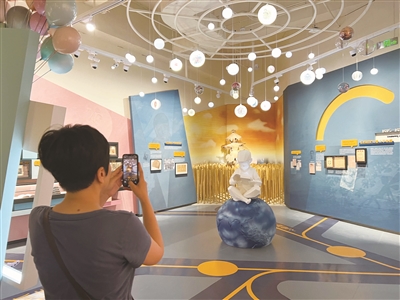
With the development of the times, the importance of children's literature in the news and publishing industry is increasingly evident. Located on the third floor, the Children's Publishing Pavilion features interactive and engaging experiences. It combines physical exhibits with textual descriptions to tell the story of the development of children's books—from the magazine "Xiao Pengyou (Kids)" spanning a century to the earliest domestic children's literary work, "The Scarecrow." From traditional picture books to comprehensive magazines that incorporate elements of handicrafts and popular science, the childhood "companions" such as Sanmao, Monkey King, the Three Monks, May Fourth, and Bugaboo have come together. The memories of summer days when "grown-ups" lay on bamboo mats, fanning themselves and watching animations, have returned. The interactive installation "One Hundred Thousand Whys" kaleidoscope allows both children and adults to have a great time playing...
Zhao Xinyun, who just finished her college entrance examination at the age of 18, embarked on her first museum trip of the summer with her grandfather. "I watched 'Huluwa' and 'The Three Monks' when I was a child, and I have vivid memories of them. Classics never go out of style. Even now, these characters are still very vivid, and my grandfather remembers them and loves them," Zhao Xinyun told reporter.
Today, technological advancements have brought more possibilities to the presentation of history and made communication more vivid and direct. Looking up, there are magnificent murals, and reaching out, there are rough stone walls. One "grotto" on the third floor seems to open a "Magic Door," leading citizens and tourists to the Kizil Caves in Baicheng County, Xinjiang. This is not a simple "relocation," but a digital "youth-preserving technique." It is reported that the staff visited Xinjiang in advance, conducted 3D scanning and data modeling of the cave, and used multiple methods to reproduce the grotto in its original location.
The fourth-floor Digital Publishing Pavilion is themed "Traveling through Time and Space" and uses 3D mapping and multimedia touch screens to introduce the history of digital publishing development in China. It focuses on the digital transformation of traditional publishing media, the innovative development of new media, and the achievements in the field of online game entertainment publishing.
Today, the urban landscape is constantly changing, and digital transformation is advancing. Technological revolution has also brought the news and publishing industry into the digital age, with knowledge carriers, communication methods, and interactive means constantly evolving. In the future, the museum will integrate with the surrounding digital media industry base, become a new model for the revitalization and inheritance of cultural relics, and at the same time, it will establish the "Shanghai Culture" brand and help Yangpu become the birthplace of branded products and activities in the news and publishing industry in Shanghai and even the whole country.
